
Guide
UGC vs Influencer Marketing: What Is the Difference?
Influencer marketing pays for reach through a creator's audience. UGC pays for the video asset itself. Brands often run UGC as ads from their own accounts - no post on the creator's feed required. UGC is usually cheaper per asset, faster to test, and easier to scale for performance marketing.
On this page
Side-by-side comparison
| Factor | UGC | Influencer Marketing |
|---|---|---|
| Primary deliverable | Video file brand owns and uses | Post on creator's own feed/stories |
| Follower requirement | None - quality beats reach | Core to the value proposition |
| Best use case | Performance ads, email, product pages | Brand awareness, launch moments |
| Cost per asset (India 2026) | Rs. 1,500-25,000 per video | Rs. 10,000-5,00,000+ per post |
| Creative control | Brand fully controls use after delivery | Limited - creator owns the post |
| Scaling | Hire 20 creators, test 20 hooks in a week | Each deal is a negotiation |
| Rights ownership | Negotiated upfront, usually broad | Post stays on creator's account |
| Measurement | ROAS, CPA, CTR on your ad account | Reach, engagement rate, branded search |
| Time to first output | 5-14 days with clear brief | 2-6 weeks for outreach and contracting |
Core difference: asset vs audience
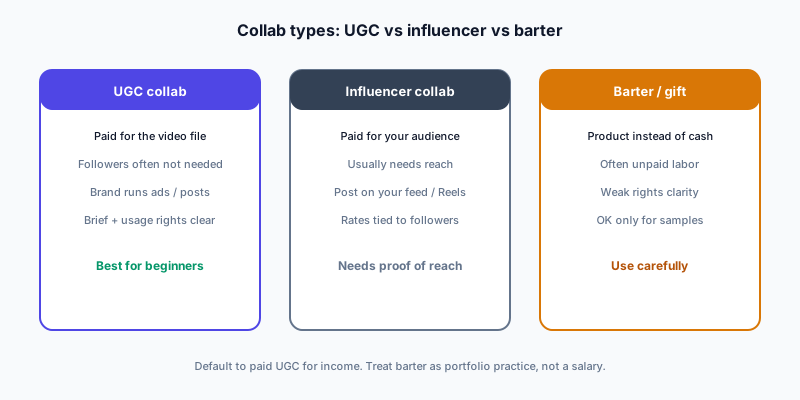
When a brand pays for UGC, they are buying a video file that they control. They can run it as a Meta ad, embed it in email, put it on a product page, or post it on their own feed. The creator's follower count is irrelevant.
When a brand pays for influencer marketing, they are buying access to the creator's audience. The post lives on the creator's feed or stories. The brand gets impressions and awareness, not a portable asset they can freely redeploy.
Cost comparison: India market estimates
Costs vary significantly by creator tier, niche, and rights scope. These are typical market ranges in 2026, not guarantees.
- UGC video (organic, 30s, no following required): ₹1,500-₹4,000
- UGC video with paid ads rights: ₹3,000-₹10,000
- Nano-influencer post (5K-20K followers): ₹5,000-₹25,000
- Micro-influencer post (20K-100K followers): ₹15,000-₹1,00,000
- Mid-tier influencer post (100K-500K): ₹50,000-₹5,00,000+
- UGC wins for creative testing volume; influencers win for brand fame and launch moments
How to measure ROI
Many India D2C teams use both channels for different goals: influencers for product launches and brand awareness, UGC for always-on ad creative testing and landing page conversion.
| Channel | Primary metric | Secondary metrics |
|---|---|---|
| UGC in paid ads | CPA, ROAS on ad account | CTR, hook rate, video completion |
| UGC on product page | Conversion rate lift | Time on page, add-to-cart rate |
| Influencer post | Reach, engagement rate | Branded search volume lift, saves |
| Influencer + UGC hybrid | Brand awareness + ROAS | Both sets of metrics above |
Which works better for Indian D2C brands?
For performance-focused D2C brands running Meta and Instagram ads, UGC outperforms on cost per acquisition in most categories because it looks like peer content rather than a branded ad. The lower cost per variant also enables more creative testing.
For brand-building - launching a new category, entering a new market, or associating with a trusted public figure - influencer posts and brand deals are harder to replicate with UGC alone.
- Start with UGC if: you run paid social ads and need to test multiple hooks per month
- Start with influencers if: you are launching a brand or category and need mass awareness fast
- Hybrid: use influencer content as creative raw material for UGC-style ads (with full rights)
- Creators with small followings earn more consistently with UGC than chasing influencer deals
For creators: which path pays more?
New creators with under 10,000 followers earn more reliably from UGC campaigns than from influencer deals. Influencer rates are tied to follower count and engagement; UGC rates are tied to video quality and rights.
A creator with 2,000 followers can earn ₹5,000-₹15,000 per approved UGC video with paid ads rights included. Earning that from a sponsored post at the same follower level is difficult unless the niche is extremely valuable.
Instagram brand collaboration and hybrid deals
Some brands want both: a video asset for ads and a post on the creator's Instagram feed. These hybrid deals price the two deliverables separately. The UGC video rate covers the asset; the feed post rate covers the reach.
For a full guide to Instagram brand collaboration in India - including outreach templates, rate negotiation, and collab post formats - see the Instagram collaboration hub linked below.
Common mistakes when comparing UGC and influencer
- Treating UGC as 'cheap influencer marketing' - they are different products with different ROI frameworks
- Running influencer-style briefs for UGC creators - the tone is different, UGC should feel authentic not scripted
- Paying for influencer reach when you only need an ad asset that never goes on the creator's feed
- No written usage rights - especially critical when running the influencer's content in paid ads without their permission
- Testing only one of each instead of running both channels for their distinct use cases
FAQ
What is the difference between UGC and influencer marketing?
UGC pays for the video file the brand uses on its channels. Influencer marketing pays for reach on the creator's audience. UGC scales creative testing; influencer buys credibility and distribution.
Can a UGC creator post the video on their own feed?
Only if the brief requires or allows it. Most UGC briefs are asset-only - the brand uses the video on their channels. If a creator also posts on their feed, that is a separate deliverable with a separate rate.
Is UGC lower quality than influencer content?
No. UGC should look native and authentic, not amateur. Brief-based UGC from verified creators with strong portfolios is produced to spec. Quality depends on the creator and brief clarity, not the channel.
Can small creators earn more with UGC than influencer deals?
Yes. UGC pays for the video, not follower count. A creator with 1,000 followers and a strong niche portfolio can earn ₹5,000-₹15,000 per UGC video with rights. An influencer deal at 1,000 followers would pay far less.
What is the difference between UGC whitelisting and influencer partnership ads?
Both run ads from the creator's account. UGC whitelisting is simpler - the brand gets ad account access to run pre-made video as an ad from the creator handle. Partnership ads are Meta's official format for influencer deals with deeper permissions.
Do Indian brands use both UGC and influencer marketing?
Yes, most scaling D2C brands use both for different goals. Influencers for launch awareness and brand association; UGC for always-on ad creative testing and performance campaigns.