
Guide
Instagram Trial Reels for UGC Creators
Trial Reels let you test hooks with non-followers before a video hits your grid - perfect practice for UGC ad creatives. Learn how to post, read insights, keep winners in your portfolio, then apply to paid brand briefs in India. Unofficial creator guide; Meta UI labels can change.
On this page
How to post a Trial Reel (quick answer)
Trial Reels mean Instagram tests your Reel with people who do not follow you before it appears on your profile grid. Eligibility: Professional account (Creator or Business), public profile, supported region (India included). Any follower count can work once the toggle appears in your app.
What Trial Reels actually do
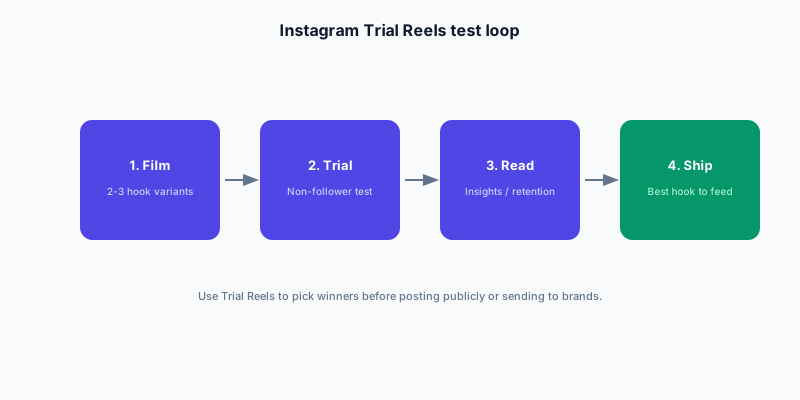
Trial Reels are a Meta distribution feature that sends your Reel to a segment of non-followers before it appears on your profile grid for existing followers. Instagram's algorithm treats it as a test: the system collects retention, likes, saves, and shares data from a cold audience, then surfaces that data in your insights.
The key difference from a standard Reel: your followers do not see the video until you choose to publish it widely. This means a weak hook does not hurt your feed engagement rate, and you can quietly kill underperformers before they drag down your account health.
For UGC creators, Trial Reels solve a real problem: you want to test multiple hook angles for the same product script, but posting 3 versions to your main feed looks spammy. Trial Reels let you run those experiments invisibly.
Who can use Trial Reels
If you do not see the Trial option in your Reel upload flow, check that your account is set to Professional mode and that the feature has rolled out to your account. Meta continues to expand access through 2026.
- Professional accounts (Creator or Business) with Trial Reels enabled in your Reel settings
- Accounts in supported regions (India is included)
- Any follower count - this is not a large-account-only feature
- Public accounts only (private accounts cannot distribute to non-followers)
How to upload a Trial Reel on Instagram
- Film your Reel as normal in Instagram or import from camera roll
- On the sharing screen, tap 'Advanced settings'
- Toggle on 'Try this reel with a wider audience first'
- Set your review window (typically 24-72 hours)
- Publish - your followers will not see it yet
- Open insights after the window closes and review retention curve, 3-second rate, and engagement
- Tap 'Share to followers' if results are strong, or archive and iterate on the hook
How to read Trial Reel insights
After a Trial Reel runs, Instagram shows you the same insight panel as a standard Reel, but the audience is exclusively non-followers. The most important numbers for UGC hook testing are:
3-second view rate tells you whether your opening line or visual stopped the scroll. Below 40% on cold audiences is a signal to rewrite the first line or change the thumbnail frame. Above 60% suggests the hook is working.
Average watch percentage reveals whether the rest of the script holds attention after the hook. A high 3-second rate but low average watch means your hook is strong but the body loses people. That is a script problem, not a hook problem.
Saves and shares on a cold audience are high-quality signals. Non-followers who save your video genuinely found it useful or entertaining, with no relationship bias inflating the number.
The hook A/B testing workflow
One script, three hook variants is the most efficient test structure. Write your core script for the product, then film three opening lines with different formats: a problem statement ('My skin was breaking out every week'), a bold claim ('I stopped using three products and my skin cleared up'), and a visual hook (hold product directly to camera in the first frame with no words).
Post each as a separate Trial Reel over consecutive days. Use identical body and CTA so that the hook is the only variable. After 24-48 hours of data on each, compare 3-second rates. The winner goes into your portfolio as a sample and into your next brand application as your proposed hook angle.
- Write core product script (body + CTA stays fixed)
- Film 3 opening variants: problem, claim, visual
- Post each as a Trial Reel on day 1, 2, 3
- Record 3-second view rate and average watch % for each
- Publish the strongest version to your main feed
- Note the winning hook type in your content tracker
Building a hook library with Trial data
After 10-15 Trial Reel experiments, patterns emerge. Most creators find 2-3 hook formats that consistently outperform for their delivery style and niche. Document these in a simple hook library: the format name, an example line, and the average 3-second rate it achieves.
This library becomes a sales asset. When you apply to a brand brief, you can propose a specific hook angle with evidence rather than guessing. Brands receive hundreds of applications; specificity with data separates serious creators from generic applicants.
For beauty niches in India, visual hooks (product on bare skin in frame 1) tend to outperform text-only hooks on Reels. For tech and app briefs, a quick problem statement before the screen demo performs well. Test your own niche before assuming.
| Hook format | How to write it | Works well for |
|---|---|---|
| Problem hook | Name a pain point the target buyer feels in plain language | Skincare, fitness, finance apps, home products |
| Before/after setup | Describe or show the before state in first 2 seconds | Beauty, home, kitchen, personal care |
| Bold claim (subjective) | State a personal result or first impression without absolutes | Supplements, skincare, productivity tools |
| Visual product reveal | Lead with product in hand or on skin, no narration | GRWM, unboxing, fashion, accessories |
| Curiosity / POV | 'POV: you finally found...' or 'No one talks about this...' | Lifestyle, discovery products, niche tools |
Best practices for UGC creators
Trial Reels work best when you treat them as a systematic tool rather than a one-off experiment. Set a cadence of 2-3 Trials per week when you are actively building portfolio samples. This gives you enough data to make confident hook decisions within a few weeks.
- Test 3 hook variants of the same script before committing to a portfolio clip
- Keep captions on for all Trials - mute viewers are a large segment on mobile feeds
- Product should appear in the first 3 seconds for brand-facing samples
- Compare 3-second rate and average watch, not just total views
- Save the winning hook line and its performance data in your tracker
- Use Trial insights to justify your rates when quoting paid ad usage rights
Trial Reels vs standard posting for portfolio building
If you post every hook experiment to your main feed, your grid becomes inconsistent and your follower engagement rate can fluctuate based on experiment quality rather than steady output. Trial Reels let you separate production (where you experiment) from publishing (where only winners appear).
A portfolio of 5 clips that all tested well on non-follower audiences is more credible than 15 clips with mixed performance. When a brand views your UGC Content portfolio, they see polished deliverables. When they view your Instagram, they see a clean, consistent creator who publishes with intent.
How Trial Reels fit into a brand application
When you apply to a brand brief on UGC Content, your application note is where Trial Reel data becomes valuable. Instead of a generic message, write something like: 'I tested 3 hook variants for a similar skincare product - the before/after setup hit 61% 3-second view rate on cold audiences. I would use that format here with your brief's specific claim.' This shows the brand you understand performance creative, not just filming.
You do not need to share the Trial Reel link itself. The insight screenshot or the metric in your note is enough. Brands care about whether your approach is evidence-based, not whether they can view your test content.
India market context
UGC in India is deliverable-based content for brands to use in ads, email, and product pages. It is different from influencer posts where reach on the creator feed is the product. Brands are buying the video asset and usage rights, not your follower reach.
Trial Reels fit this model well: you are optimizing the quality of the creative output, not chasing viral moments for your own account. Indian brands running Meta ads care about cost-per-result on their campaigns. A creator who can show evidence of hook performance on cold audiences is easier to justify hiring at a higher rate.
Whether you film in Hindi, Hinglish, or English, test the same hook across languages if you offer multilingual content. Retention data by language gives you and the brand a clearer picture of which script version to brief.
How to apply this on UGC Content
Creators on UGC Content find paid work through live brand briefs. Verification and an eligible creator plan are required to apply. Use Trial Reel data alongside your portfolio to strengthen applications and stand out in competitive brief pools.
- Complete verification and connect Instagram if the brief requires it
- Upgrade to Creator Pro or Studio when you are ready to apply to paid briefs
- Run Trial Reel experiments to build 5+ niche portfolio samples with performance data
- Apply with a specific hook idea, cite your Trial Reel metrics if relevant
- Upload final deliverables on-platform and respond to revision notes within hours
Common mistakes to avoid
Most rejections come from audio, weak hooks, or unclear rights quotes. Fix these habits before you raise your rates.
- Applying without reading the brief or proposing a specific hook angle
- Quoting base rate while the brief includes paid ads or whitelisting
- Delivering via external links instead of the platform upload flow
- Ignoring compliance lines for finance, health, or beauty claims
- Missing deadline without proactive message to the brand
- Skipping captions on deliverables intended for ad placements
Quick recap
- Trial Reels test with non-followers before your feed sees the video
- Test one script with three hook variants; measure 3-second rate and average watch
- Build a hook library from your Trial data and reference it in applications
- Captions on, product visible in first 3 seconds, clean audio
- Save winning hooks for portfolio clips and media kit metrics
Key terms
| Term | Meaning |
|---|---|
| Trial Reel | Reel shown to non-followers only for testing; not published to follower feed until you choose |
| 3-second view rate | Percentage of viewers who watched past the 3-second mark; main hook quality signal |
| Average watch % | Percentage of video duration watched on average; reveals script retention past the hook |
| Usage rights | Where and how long the brand may use your video (organic, ads, web, email) |
| Application note | Short message with hook idea and why you fit the brief |
| Portfolio | Public samples in one niche; brands hire on clips, not follower count |
FAQ
How to post a Trial Reel on Instagram?
Create a Reel, tap Advanced settings on the share screen, toggle Try this reel with a wider audience first, choose your review window, and publish. After the trial period, open insights and tap Share to followers if results are strong.
How to upload a Trial Reel on Instagram?
Import or film your Reel, open Advanced settings on the share screen, enable the Trial Reel toggle, set the review window, then publish. That is the upload path for a Trial Reel before you share to followers.
How to post Trial Reels on Instagram?
Use the same Advanced settings toggle for each Reel you want to test with non-followers. Run separate trials for hook variants, read insights after each window, then share winners to your grid.
Who is eligible for Trial Reels in India?
Professional Instagram accounts (Creator or Business) with a public profile in supported regions including India. Any follower count can qualify once Meta enables the toggle on your account. Update the app if you do not see the option.
What do Trial Reels mean on Instagram?
Trial Reels mean Instagram shows your Reel to non-followers first as a test. You get performance data before followers see it on your grid. It is a hook-testing tool, not a separate content format.
Where do I find Trial Reel insights?
Open the Reel from your profile Trial reels section or activity, then tap View insights. You will see retention, 3-second view rate, likes, saves, and shares from the non-follower test audience.
Do you need 1,000 followers for Trial Reels?
No fixed follower minimum for all accounts. Meta rolls out Trial Reels by region and account type. Many creators with small followings see the toggle on Professional accounts. If missing, confirm Professional mode and update the app.
How long does a Trial Reel test run?
Most Trial Reels run 24-72 hours depending on the window you choose at publish. Instagram collects non-follower engagement during that period before you decide to share widely or archive.
Can you delete a Trial Reel after posting?
Yes. Archive or delete a Trial Reel like any Reel. If you never share to followers, most of your audience never sees it. Weak trials do not affect main-feed engagement rate.
Do Trial Reels hurt reach on my main feed?
No. Trial Reels are isolated from your follower feed until you choose to publish. A weak Trial Reel does not drag down your account engagement rate.
Can brands see my Trial Reels?
Not directly. Share portfolio clips and insight screenshots separately. Trial Reels are for your own testing and growth experiments.
How many Trial Reels should I run per week?
Two to three Trials per week gives you enough data to spot patterns within a few weeks. Start with one script, three hook variants as your first experiment.
How does Trial Reel data help me earn more from UGC briefs?
Stronger hooks in applications win more campaigns. Data on cold audience 3-second rates justifies higher rates for paid ad usage rights and makes your application stand out.
Does UGC Content guarantee campaign results?
No platform guarantees ROAS or earnings. UGC Content provides brief-based hiring, wallet pay-on-approval, and creator tools. Performance depends on your offer, creative quality, and media buying.
What do creators need before applying to briefs?
Complete verification, an active Creator Pro or Studio plan, Instagram connected when required, and 3+ niche portfolio clips. Application notes with a hook idea outperform generic messages.